
Household Emergency Plan Template
This emergency plan was developed to be fully customizable for your family. Every emergency is different, and every household and family is different, so you should be able to make your plan as best suits everyone living in your household!
We have divided the plan into 5 short sections; you can do one section at a time or all at once. There are also 4 optional sections. Each section has a PDF you can either fill out on your computer or print and fill out by hand. Then, to the right of each section, we have listed resources you can use to help you make your plan!
You can do it! Just do a little bit each week and in no time you will be better planned for emergencies!
Step 2: The Household Information Sheet
Print as many copies of this form as you need to have an individual section for each household member.
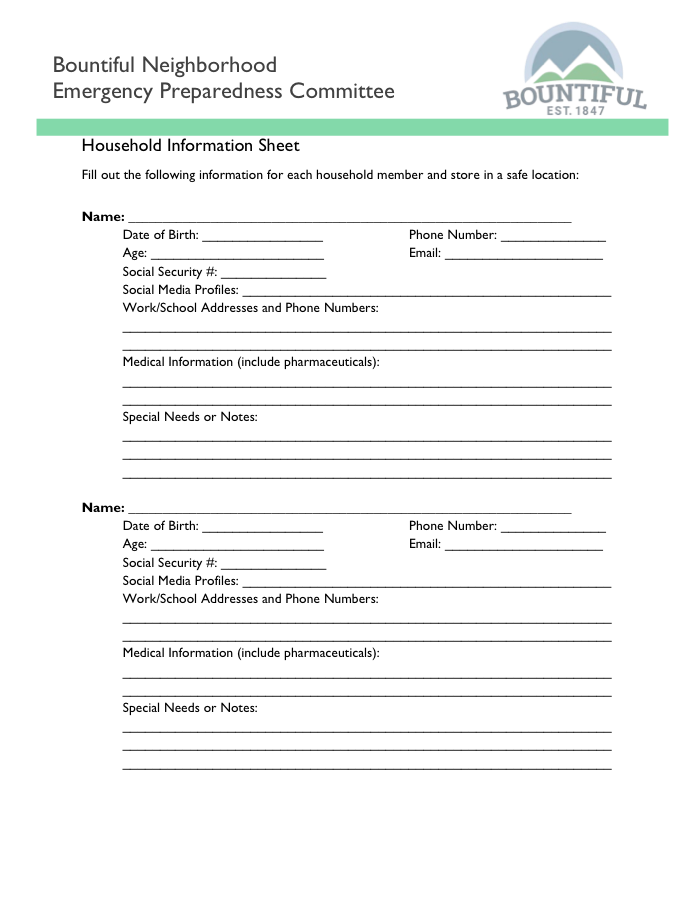
The Household Information Sheet is an important part of emergency preparedness. It will help you think through each member of your household and what they may need in an emergency. It also provides responders important information. Make special note of any unique circumstances.
Children and infants are often confused in emergencies and will be unsure what to do. They may be frightened and act out. Plan and practice emergency skills with them often.
For more guidance on how to prepare with children or infants in your household, visit these resources:
Seniors often have unique needs in emergencies. Many have disabilities, live on their own, or struggle with mobility. Take special consideration if there is a senior individual in your household.
Learn more about emergency preparedness for seniors by exploring these resources :
Individuals with disabilities or significant medical problems need special consideration when making emergency plans. Consider all of their necessary equipment, such as oxygen, a wheelchair, or a walker, and how they may respond in an emergency.
For resources about emergency preparedness for those with disabilities, visit these resources:
Step 3: The Household Communication Plan
Fill out contact information for each family member. Answer the questions on the last page according to your household’s situation using the information resources on the right.
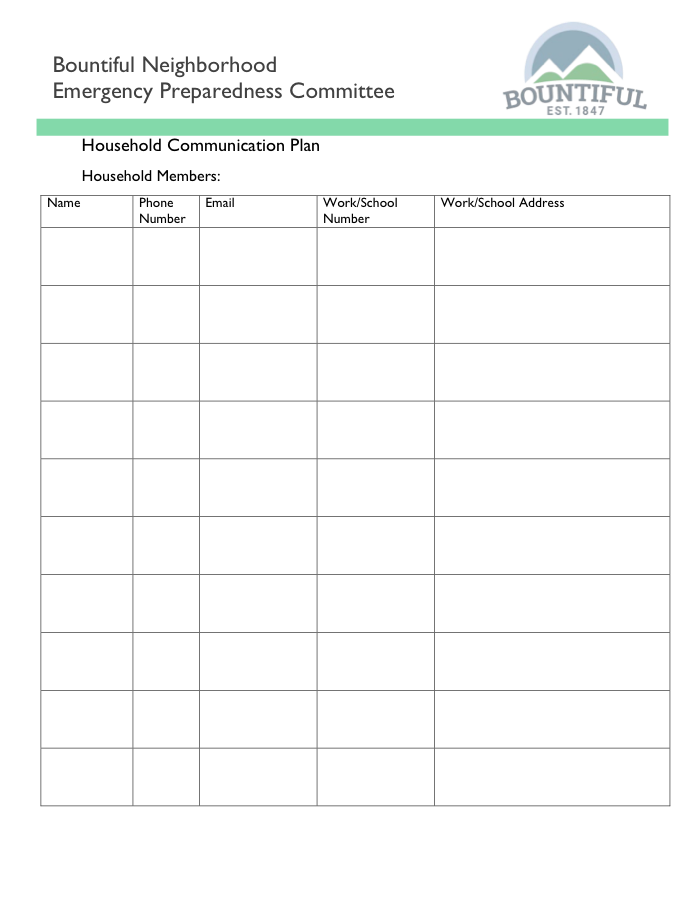
Communication is key in an emergency, and in major disasters normal ways of communication often can’t be used.
For personal life-threatening emergencies, always call 911. For large-scale neighborhood disasters, where professional responders will be overwhelmed, the Bountiful Volunteer Emergency Response system will be activated. During these times, you should post your red and green colored card outside in a visible location and contact your block captain. Learn more about the Bountiful neighborhood disaster response system by clicking here.
Always have local and out-of-state emergency contacts to assist your household and also provide a single point of communication if your household is separated in a disaster. In large disasters, it may be easier to make long-distance phone calls because local lines can get heavy traffic.
Learn more by exploring these resources:
To get emergency alerts around Bountiful City, you can follow the news, the radio, or our social media networks. Find us on Facebook and Twitter.
You can also read FEMA’s recommendations here.
In emergencies, you can communicate in-person, by phone, by radio, by email, by social media, and so on. Figure out the ways that will work best for your household and make sure everyone is aware of the methods your household chooses.
Learn about HAM radio by clicking here.
Family Communication Card Printables (wallet-sized):
Step 4: Shelter and Evacuation Plan
Fill out the first two forms about sheltering and evacuating. If you have pets or livestock, fill out the optional forms. For help completing the forms, refer to the resources on the right.
Download Step 4a — Shelter Plan (PDF)
Download Step 4b — Evacuation Plan (PDF)
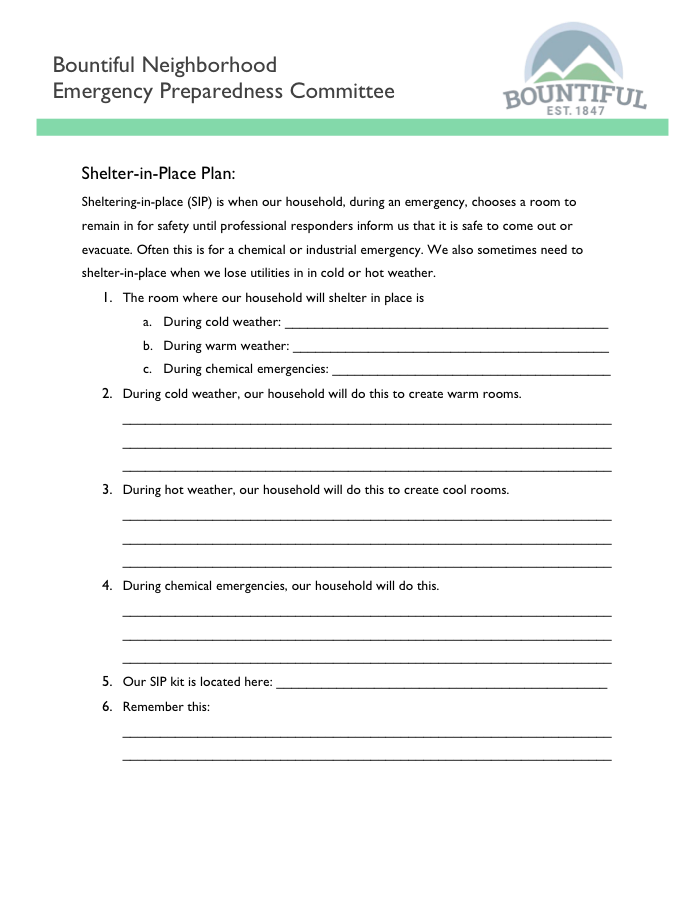
In large disasters, you may be asked to either stay at home and shelter-in-place or to evacuate. Always follow emergency personnel’s instructions.
You will usually be told by emergency personnel whether or not to evacuate or shelter-in-place. If something in your home or shelter is creating a hazard, such as a gas leak or fire, then you will need to evacuate.
Follow this guide to prepare to shelter in place: Be Ready Utah’s Sheltering Guide.
You could be anywhere when a disaster takes place, so it’s important to have a predetermined meet-up location for the members of your household.
Choose locations that are specific, such as by the mailbox or at grandma’s house, and that everyone is familiar with.
You may need to evacuate your house, your neighborhood, or even your city. Walk through your house and pick two exit routes from each room. Is it better to go out the back door or the front? Can you go out any windows?
Make sure evacuation routes in your house will be clear of obstacles and don’t block too much of your line of sight.
Be aware that if you are asked to evacuate your neighborhood, there may be a lot of car traffic. Always keep at least half a tank of gas in your car and get regular maintenance. Remain calm and follow traffic signs and personnel.
For tips on how to decide evacuation routes in your home or neighborhood, follow these resources:
If you want a form your children can fill out about evacuation and meeting places, use this: FEMA Family Communication Plan for Kids.
If you have any pets or livestock, think about how you can help them in an emergency. Often mass shelter sites don’t allow animals. Print out the optional pet or livestock forms and fill them out to be included in your household plan. For help and ideas, explore these resources:
Step 5: Emergency Kits
Create a customized emergency kit list by exploring the resources at right and selecting items that apply to your family. Create as many custom kits as you need for your household.
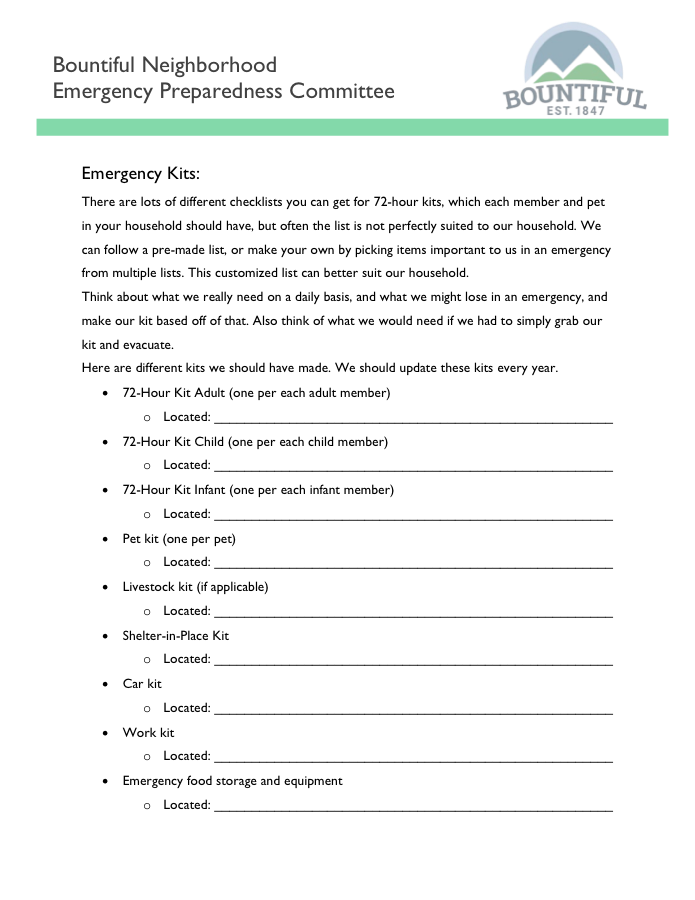
Have emergency needs set aside in a location you can easily grab and go from. Update your kits regularly as your needs and household members change.
Having back-up food storage and emergency supplies can be a big help to your family in case of neighborhood or family disaster, such as losing a job.
Here are some recommendations for what to include in your home emergency storage:
72-Hour kits are a great way to have everything you need in an emergency easily and quickly accessible. There are lots of checklists out there, but we recommend making a list that best suits your family. You can use other lists as a guide. Here are some lists adapted to different individuals:
- Just the Basics: FEMA Emergency Supply List
- Adults
- Children
- Infants
- Preparedness Mama Infant Checklist
- The Survival Mom Infant Checklist (scroll down to get to the bulleted list)
- Seniors
- Disabilities
- Pet Kits
- FEMA Pet Kit (see first page)
Store your shelter-in-place kit in an easily accessible location.
For a list of what to include in a shelter-in-place kit, see the second page of this document: Be Ready Utah’s Sheltering Guide.
You may have an emergency in your car, such as being stuck in traffic in winter, having a flat tire, or being stranded without gas. You also may need to use your car to evacuate. Because of this, it is critical to have an emergency kit in your car.
Here are some different car checklists that have been put together:
You probably spend a large amount of your time at work, and so it’s important to be prepared in your office as well. Learn about your workplace’s emergency procedures and have an emergency kit with you at work.
Here are some checklists for work kits:
- Be Ready Utah Disaster Supply Kit (see second page)
Optional Additional Forms
The following sheets allow you to record important information about your household and have that information in an easy to locate place. Often in emergencies you need to be able to have documentation readily and quickly accessible. There are also some resources to help you know what to do in specific kinds of disasters. Fill out the following forms to become even more prepared!
Step 6: The Household Assets and Insurance
Use the resources on the right to make a plan regarding your personal property.
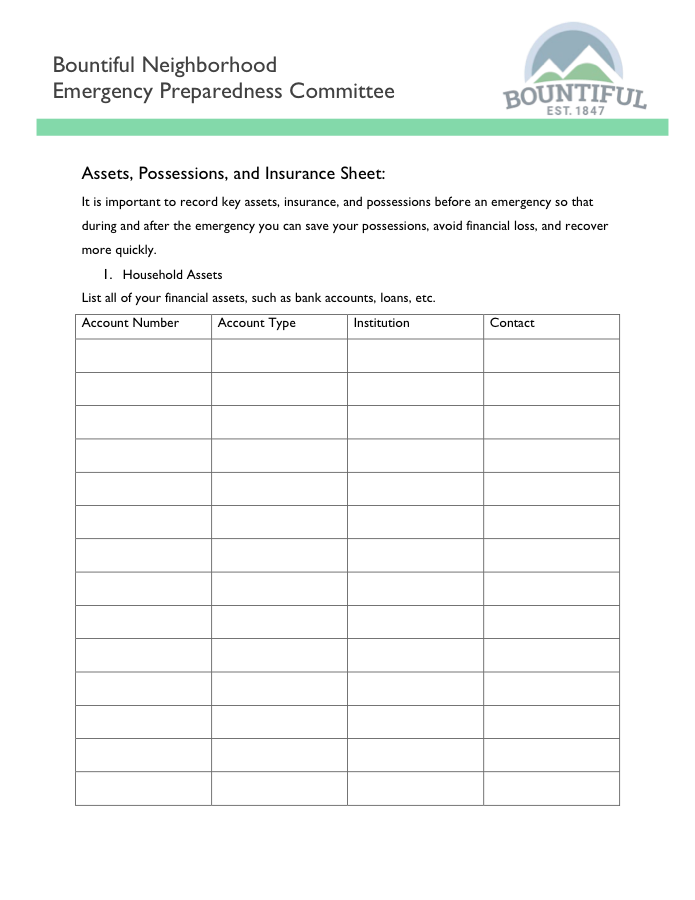
Although the most important thing in an emergency is to take care of you household members, your property is still a serious concern. Having a plan about your insurance and assets helps with emergency recovery.
When recovering from an emergency, insurance can often help. Be sure to know who to contact at your insurance agency and be familiar with what is covered in your policy.
Here are additional resources about insurance:
You should make a list of all of your assets. This includes bank accounts, credit cards, loans and debt, and any investments.
You also should record all of your valuable items in your home. In an emergency many items may be lost, but sometimes items can be recovered. Include the location of the item in your home. Think of items both with high monetary and sentimental value, but also realize that in an emergency, human life is more important to protect. Don’t ever risk your life to save any possessions.
One good way to keep a record of your possessions and assets is to walk around your home and video or take pictures of all your important belongings. You can then store these or even send them to your insurance agent.
When trying to decide what items to take if you do have time when you are evacuating, think about what matters most to your household’s well-being and what is easy to transport. Be mindful of the time constraints. The emergency kits and important documents lists can help guide your decisions.
For more guidance on personal assets, check out these resources:
Have copies of all your important documents, like birth certificates and passports. For a list of these documents, use this resource: Be Ready Utah: Important Documents Checklist
Step 7: The Home Information Sheet
Use the resources on the right to record information about your home.
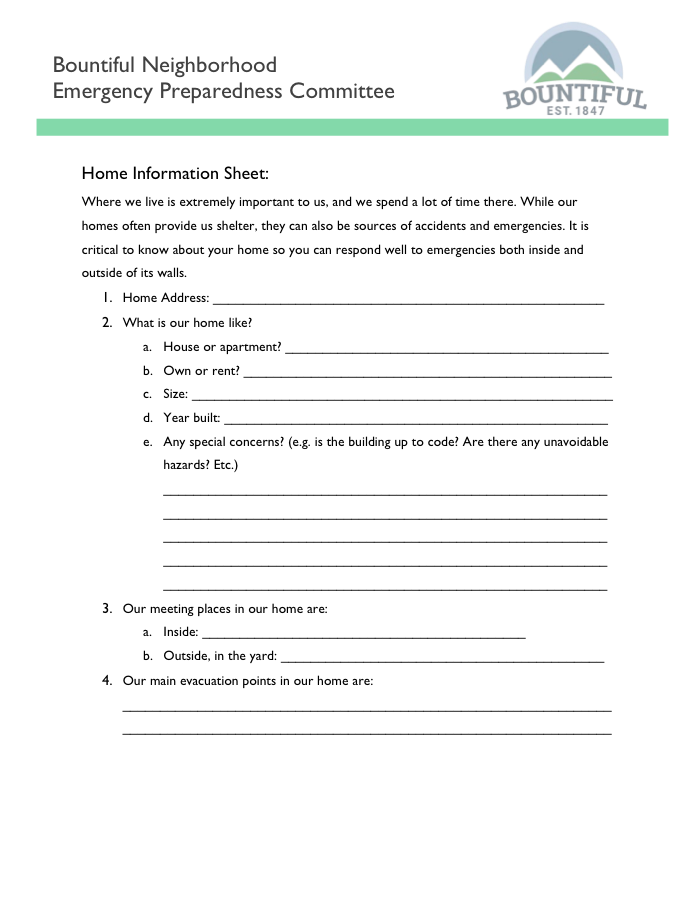
Prepare your home for emergencies and be familiar with how it functions.
Utilities make our lives easier and more convenient, but they also can cause hazards in our homes. Be familiar with how you get your gas, water, and electric, and know how to switch on and off all of these off in your home.
For advice about utilities in emergencies, visit these resources:
There are things you can do now to prevent emergencies in your home. Follow these resources to make your home emergency ready:
Households that live in apartments should still be familiar with the utilities and construction of the apartment complex. Here are some resources for emergency preparedness in apartments:
- Apartment Search Tips
- Ready.gov Plan for Locations (scroll down to “Neighborhoods, Condominiums, and Apartments”
Step 8: The Car Information Sheet
Use the resources on the right to record information about your car.
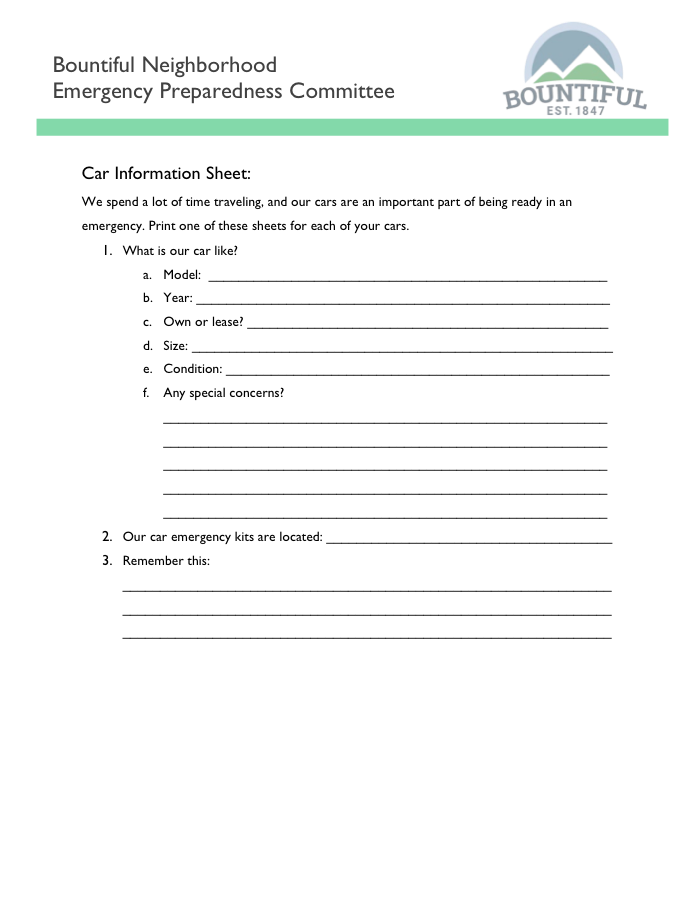
Your car can be an asset in an emergency, helping you and your household evacuate. It needs to be ready for disasters.
Know when your car’s registration and maintenance is due. Get regular oil changes and always have at least half a tank of gas in your car. For a checklist of car maintenance, visit these resources:
You may have an emergency in your car, such as being stuck in traffic in winter, having a flat tire, or being stranded without gas. You also may need to use your car to evacuate. Because of this, it is critical to have an emergency kit in your car.
Here are some different car checklists that have been put together:
Step 9: What do we do when…
Using the resources on the right, fill out the templates with facts and tips about dealing with specific kinds of disasters.
Every emergency is different and has different considerations. Explore tips specific to emergencies common in Bountiful below.
Hazard sheets (PDF):
Fires can be isolated to one home or affect an entire community. Wildfires can also be an area of serious concern and threaten many properties and lives. Use these resources to learn more about the best actions to take during a fire-related emergency.
Floods can happen because of excess rainfall or snow melt, broken water lines, or several other reasons. Learn how best to deal with floods by exploring resources below.
Bountiful sits on a large fault line that many experts expect is due for a 7.0 magnitude earthquake. Earthquakes present significant hazards, but there are certain actions you can take to best protect yourself and your loved ones. Learn how best to deal with earthquakes by exploring resources below.
Storms, through lightning and wind, can cause trees to fall, property to be damaged, and injuries from flying debris. Bountiful regularly gets powerful wind storms that have caused considerable property damage. Learn how best to deal with wind and storms by exploring resources below.
Though Utah is in a desert, it can get heavy snowfall that knocks out power lines, creates dangerous roads, and heightens risk of falls and hypothermia. Learn how best to deal with snow, ice, and excessive cold by exploring resources below.
During the summer months our area can become incredibly hot. This heat often leads to dehydration and heat illnesses, and if you lose utilities during a heat spell you could be in trouble. Learn how best to deal with excessive heat by exploring resources below.
Nearby industrial facilities, railroads, or chemical transport vehicles can have accidents and put our area at risk. Learn how best to deal with chemical and industrial accidents by exploring resources below.
Terrorism is a real threat in our society. Learn how best to deal with terrorist attacks by exploring resources below.
Any kind of emergency could happen in Bountiful. Explore other resources and fact sheets about emergencies here:
Steps 1-9: The Entire Plan Template
If you would rather just print out the whole emergency plan template at once, we have combined all of the forms into one document here. It does NOT include optional forms such as pet plans, livestock plans, or extra car plans and household information sheets.
In addition, a fantastic summary of general citizen preparedness is provided in FEMA’s Are You Ready? An In-Depth Guide to Citizen Preparedness. The manual is 200 pages, but full of clearly explained information and diagrams. If you want to get deeper into emergency preparedness, check it out!
Have a great emergency preparedness resource? Let us know! Contact our webmaster!